
Methi no masalo: the complete guide
Methi masala,
explained by Nani.
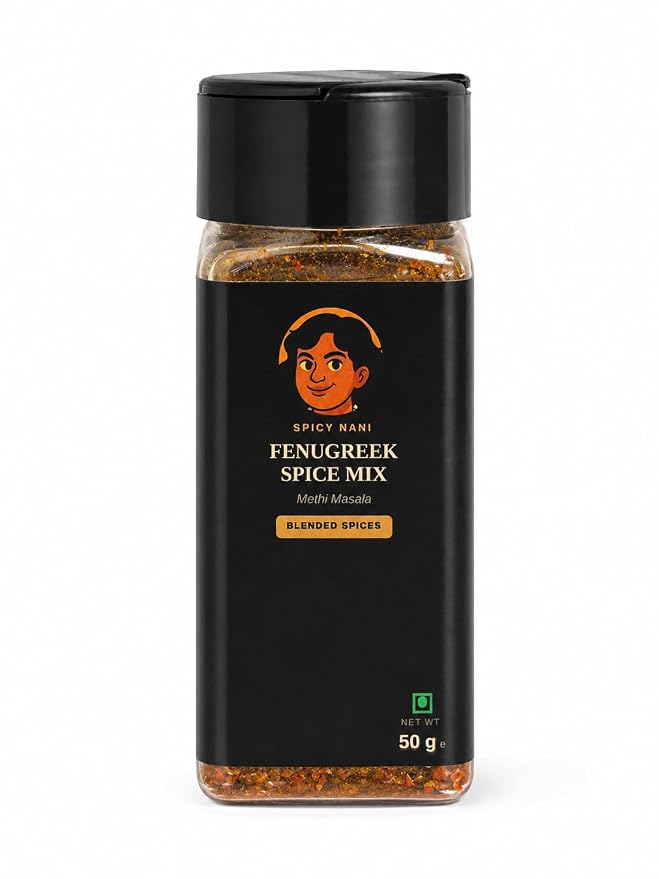
What Gujarat's fenugreek spice blend is, how it differs from kasuri methi, and how to actually use it. Ours is 100% vegan and preservative-free, made by hand in small batches in Ahmedabad.
What is methi no masalo?
Methi no masalo is a coarse, oil-bound spice blend from Gujarat built on split fenugreek seeds — known as methi dal or methi na kuria. It is not a powder and not a curry masala. It is closer in character to a dry pickling paste: coarse, salty, pungent, and bound together with mustard oil so that it keeps for months without refrigeration.
In Gujarati homes it has two jobs. The first is as the base of athanu — pickle, most famously raw mango pickle (keri nu athanu). The second, less known outside Gujarat, is as a condiment eaten straight: a spoonful alongside thepla, rotla, khichdi or plain dal rice.
The blend is regional and varies house to house. Most versions share a core of split fenugreek, red chilli, split mustard (rai dal or rai na kuria), turmeric, asafoetida (hing), salt and mustard oil. The proportions are what distinguish one family's masalo from another's.
The names it goes by
The same blend appears under several spellings and regional names, which is part of why it is hard to search for:
- Methi no masalo — the standard Gujarati form (literally "the masala of methi")
- Methiya masala / methia masala — common transliteration, widely used in Saurashtra and Kathiawad
- Methi masala — the shortened form, though this is ambiguous and sometimes used for unrelated fenugreek-leaf curry mixes
- Achar masala / pickle masala — describes its function rather than its contents; most achar masalas sold in Gujarat are methi-based, but not all
- Methi na kuria masala — referring to the split-seed form of the fenugreek
If you have seen it written any of these ways, it is the same family of blend.
Methi no masalo vs kasuri methi
This is the single most common mix-up, and it matters because the two are not substitutes in any dish.
| Methi no masalo | Kasuri methi | Methi dana | Methi powder | |
|---|---|---|---|---|
| What it is | A blended spice mix | Dried fenugreek leaves | Whole fenugreek seeds | Ground fenugreek seeds |
| Part of plant | Seeds (split), plus other spices | Leaves | Seeds | Seeds |
| Form | Coarse, oily, bound | Dry, crumbly, leafy | Hard whole seeds | Fine dry powder |
| Taste | Salty, pungent, sharp | Faintly bitter, savoury, aromatic | Very bitter raw | Intensely bitter |
| Typical use | Pickles; eaten as a condiment | Crumbled into North Indian curries, dals, parathas | Tempering, pickles, sprouting | Small quantities in spice mixes |
| Can it substitute the others? | No | No | No | No |
The short version: kasuri methi is a herb you sprinkle into a curry. Methi no masalo is a condiment you eat. If a recipe asks for one and you use the other, the dish will not work.
A second distinction worth noting: methi no masalo is not the same as a generic "achar masala." Achar masalas across India vary enormously by region — a Punjabi or Rajasthani pickle masala will usually be fennel- or nigella-forward, where the Gujarati version is defined by the split fenugreek.
What goes into it
A representative Gujarati blend contains seven ingredients and nothing else. Here they are, straight from the label of our jar:
- Methi Dal22.8%
Split fenugreek seeds give the toasty, gently bitter flavour, and much of the plant protein (11.5 g per 100 g of masala).
- Iodised Salt27.4%
Salt does the preserving, which is why there are no preservatives. It's how achar masala has always been kept.
- Red Chilli20.1%
Brings the heat and the deep red colour. No artificial colour needed.
- Rai Dal13.7%
Split mustard seeds add the sharp, nose-tingling bite that Gujarati achar is known for.
- Mustard Oil12.3%
Binds the spices and helps keep the masala fresh. The traditional pickling oil across India.
- Turmeric3.4%
Adds warmth and golden colour, as it has in Indian kitchens for generations.
- Hing0.4%
A pinch of asafoetida rounds out the flavour with a savoury depth.
What a traditional blend does not contain: artificial colours, anti-caking agents, flavour enhancers, or synthetic preservatives. If a jar lists those, it has been made for shelf life in a warehouse rather than in the traditional manner.
How it is made
The traditional method is slow and it is where quality is won or lost:
- Sorting and cleaning the fenugreek and mustard seeds.
- Splitting the fenugreek into dal — not grinding it. This is the step that separates a proper masalo from a powder.
- Light toasting, which develops the maple-toasty aroma fenugreek is prized for and takes the raw edge off the bitterness. Over-toasting makes the whole batch bitter, and there is no recovering it.
- Blending the dry spices in the house's own proportions.
- Binding with mustard oil, usually heated and cooled before it is added, then rested so the oil penetrates the split seeds.
- Resting for a day or more before jarring, which lets the flavours settle.
Done in small batches, this takes care and attention at every step. Done industrially at scale, the toasting is where most of the character is lost.
How to use methi no masalo
This is the question most first-time buyers have, and the answer is broader than most people expect.
As a pickle base
Keri nu athanu (raw mango pickle)
The classic. Cut raw mango into pieces, salt and dry them, then combine with the masalo and additional mustard oil. Rest in the sun.
Lemon, chilli or mixed vegetable pickles
The same principle with different produce.
Quick instant pickle
Toss the masalo with raw mango or carrot and use within a few days, without the sun-curing step.
As a condiment, eaten directly
With thepla
A spoonful on the side is the standard Gujarati travel meal.
With rotla or bajra roti
Especially in Saurashtra, with a little extra oil or ghee.
With khichdi and kadhi
A small amount cuts the richness.
With dal rice
A sharp counterpoint to something plain.
With curd rice or plain yoghurt
The salt and heat against the cool dairy.
As a cooking ingredient
Stirred into sabzi
A teaspoon into potato, okra or aubergine while cooking.
Into dal
A small amount added near the end.
Mixed into thepla or paratha dough
Folds the flavour through the bread itself.
Rubbed on vegetables before roasting
Not traditional, but it works well with potatoes, cauliflower and paneer.
Stirred into yoghurt as a dip
The simplest way to taste it on its own.
Quantity guidance: start with less than you think. This is a salt-forward, concentrated blend — a teaspoon goes a long way, and a dish is easy to over-salt with it. Taste before adding salt separately to anything you have used it in.
Methi no masalo recipes
Masala thepla
The travel flatbread of every Gujarati family, with the masala kneaded right into the dough.
You need
- 2 cups wheat flour
- 1 cup chopped fresh methi leaves
- 2 tbsp Spicy Nani methi masala
- 3 tbsp curd
- 1 tbsp oil, plus more for cooking
Method
- Mix flour, methi leaves, methi masala, curd and oil. Knead into a soft dough with a little water.
- Rest for 10 minutes, then roll into thin rounds.
- Cook on a hot tawa with a little oil until golden spots appear on both sides.
Gujarati kadhi
Sweet-sour yoghurt kadhi with a spoon of masala in the tadka for heat and depth.
You need
- 1 cup sour curd
- 2 tbsp besan
- 1 tsp jaggery
- 1 tsp Spicy Nani methi masala
- 1 tbsp ghee or oil, curry leaves
Method
- Whisk curd, besan and 2 cups water until smooth. Simmer, stirring, for 10 minutes with jaggery.
- Heat ghee or oil, add curry leaves, then turn off the heat and stir in the methi masala.
- Pour the tadka over the kadhi and serve with rice or khichdi.
Dal with masala tadka
Everyday toor dal finished with methi masala bloomed in hot oil.
You need
- 1 cup toor dal, pressure-cooked
- 1 tbsp oil
- 1 tsp Spicy Nani methi masala
- Lemon and coriander to finish
Method
- Whisk the cooked dal with water to the consistency you like and bring to a simmer.
- Warm the oil, take it off the heat and stir in the methi masala for 10 seconds.
- Pour over the dal, squeeze in lemon and top with coriander.
Instant raw mango pickle
A quick Gujarati keri nu athanu made with methi no masalo — no sun-curing required, ready to eat the next day.
You need
- 250 g raw mango, diced small
- 3 tbsp Spicy Nani methi no masalo
- 2 tbsp mustard oil
- Salt to taste (taste first — the masalo is already salted)
Method
- Wash and dry the raw mango completely. Any water left on the surface will spoil the pickle. Dice into small even pieces.
- In a dry bowl, mix the diced mango with the methi no masalo until every piece is coated.
- Warm the mustard oil until it just smokes, then cool it completely. Pour over the mango and mix through.
- Transfer to a clean dry jar. Rest overnight at room temperature before eating. Refrigerate and use within two weeks.
Masala paratha
Layered paratha with masala folded between the layers for a crisp, spicy bite.
You need
- 2 cups wheat flour dough
- 2 tsp Spicy Nani methi masala
- Ghee or oil
Method
- Roll a ball of dough into a round, brush with ghee and sprinkle with methi masala.
- Fold into a triangle or square and roll out again.
- Cook on a hot tawa with ghee until crisp. Serve with curd.
Storing it
- Keep in a cool, dry place, away from direct sunlight.
- Always use a dry spoon. Water is the enemy of any oil-bound masala and is the usual cause of spoilage.
- Refrigerate after opening to extend life, particularly in humid coastal conditions or through a monsoon.
- A well-made blend keeps for months. The oil may separate and settle on top — this is normal; stir it back through.
- Signs it has gone: a rancid or stale-oil smell, visible mould, or any sign of moisture.
Vegan & preservative-free: why it matters
Many packaged masalas and pickle mixes use artificial preservatives such as sodium benzoate, synthetic colours and anti-caking agents to sit on shelves for longer. We don't. Our methi masala relies on the two natural keepers Indian kitchens have trusted for centuries: salt and mustard oil.
It is also fully vegan, so it suits plant-based, vegetarian and dairy-free diets alike. If you are looking for vegan spices or preservative-free masala you can trust, this is exactly what Nani has always made at home.
Frequently asked questions
- What is methi masala?
- Methi masala (methi no masalo, also spelt methiya masala or methia masala) is a coarse, oil-bound Gujarati spice blend built on split fenugreek seeds (methi dal), combined with red chilli, split mustard (rai dal), turmeric, hing, salt and mustard oil. It is the base for Gujarati pickles such as raw mango achar, and is also eaten directly as a condiment alongside thepla, rotla, khichdi and dal rice.
- Is methi masala the same as kasuri methi?
- No, and they are not substitutes. Kasuri methi is dried fenugreek leaves, crumbled into North Indian curries and dals as a finishing herb. Methi masala (methi no masalo) is a blended spice mix made from split fenugreek seeds bound with mustard oil, used for pickles and eaten as a condiment. One is a leaf, the other is a seed-based blend.
- Is methi masala bitter?
- A well-made blend should not be dominated by bitterness. Fenugreek is bitter when raw, but splitting and lightly toasting the seeds tames it considerably, and the salt, chilli and mustard oil balance what remains. The result should taste toasty, sharp and savoury with a gentle bitterness underneath. Harsh bitterness usually indicates over-toasted or poorly sorted seeds.
- Is Spicy Nani methi masala vegan?
- Yes, it is 100% vegan. Every ingredient is plant-based: methi dal, red chilli, rai dal, mustard oil, turmeric, hing and iodised salt. There is no dairy, ghee, honey or any animal product.
- Why is salt so high in the ingredient list?
- Salt is doing preservation work, not just seasoning. Together with mustard oil it is the traditional preservation system that allows the blend to keep for months without synthetic preservatives. This is why the blend should be used sparingly, and why you should taste before adding further salt to any dish you have used it in.
- How is methi masala different from garam masala?
- Completely different. Garam masala is a warm, aromatic finishing powder based on cinnamon, cardamom, clove and cumin. Methi no masalo is a coarse, salty, oil-bound pickling blend. They share no role in a kitchen.
- How do I use methi masala?
- Three ways. As a pickle base, most commonly for raw mango pickle (keri nu athanu). As a condiment eaten directly alongside thepla, rotla, khichdi, kadhi, dal rice or curd rice. And as a cooking ingredient stirred into sabzi or dal, mixed into thepla dough, or rubbed on vegetables before roasting. Start with a small quantity, as the blend is concentrated and salt-forward.
- How should I store my spices?
- Store in a cool, dry place away from sunlight, and refrigerate after opening. Always use a dry spoon, as moisture is the usual cause of spoilage in oil-bound blends. Oil separating and settling on top is normal — stir it back through.
- Can I make methi masala at home?
- Yes, and many Gujarati families still do, usually in a large annual batch at the start of mango season. The barriers are sourcing good split fenugreek, judging the toast correctly, and having somewhere to rest and store a large quantity.
- What should I look for when buying methi masala?
- A short ingredient list with no artificial colours or preservatives; split fenugreek rather than ground; a declared proportion breakdown if available; a recent manufacturing date, since oil-bound blends are best fresh; and a visible FSSAI licence number.
About Spicy Nani
Spicy Nani makes methi no masalo in small weekly batches in Ahmedabad, Gujarat, from a family recipe — hand-toasted, split rather than ground, and bound with mustard oil. Seven ingredients, no artificial colours or preservatives, 100% vegan. Each jar arrives in a glass-top wooden box with a comic card telling Nani's story.